









European Accessibility Act · EAA compliance · EN 301 549 · WCAG 2.2
European Accessibility Act – the EU Directive that makes accessibility mandatory across Europe.
The European Accessibility Act forms the European framework upon which national laws, such as the German BFSG, are based. Since 28 June 2025, uniform accessibility requirements for many digital products and services have applied across the EU. Anyone offering products or services to consumers in Europe is affected – regardless of where the company is based. On this page, we explain in simple terms what the EAA requires, how it relates to the BFSG and EN 301 549, and how you can document conformity for several EU markets with one audit. It also applies to companies from the US, the UK and other countries outside the EU that sell products or offer services to consumers in the EU.
Trusted by leading companies across the DACH region
Featured as an expert on ZDF WISO










What the European Accessibility Act is and why it affects the whole of Europe
The European Accessibility Act, or EAA for short, is EU Directive 2019/882, which was adopted in April 2019. Its aim is to harmonize the accessibility rules of the Member States, which until then had varied considerably. Instead of 27 disparate national systems, a common standard now applies – this simplifies the single market and makes accessible products more widely available.
Since 28 June 2025, the EAA has been applicable throughout the EU, implemented through the national legislation of each Member State – in Germany through the Accessibility Strengthening Act. This means that accessibility is finally no longer a voluntary gesture, but a consumer right that can be enforced across Europe.
How EAA, BFSG and EN 301 549 are connected
These three terms are often confused, yet their relationship is clearly defined. The European Accessibility Act is the directive at European level; it sets out the objective and the framework, but deliberately does not prescribe any technical details. Member States must transpose this framework into national law – in Germany this is done through the BFSG, in Spain, for example, through Law 11/2023, and in Italy and France through their own implementing legislation. Finally, the specific technical standard is provided by EN 301 549, which in turn uses the WCAG as its foundation. One can think of it as three levels: the EAA determines the ‘what’, the BFSG the ‘where’ and ‘how’ of enforcement, and EN 301 549 the technical ‘how’ of implementation.
Who the EAA applies to – even beyond the EU’s borders
The EAA covers precisely those products and services that are particularly important to people with disabilities and which, until now, have been regulated in a highly inconsistent manner. These include computers and operating systems, smartphones, e-book readers and self-service terminals, as well as online shops, banking services, telecommunications services, e-books and passenger transport. A crucial – and often overlooked – factor is the scope: As with the GDPR, it is not the company’s place of business that matters, but the market. Anyone offering services to consumers in the EU falls under the EAA, even if the company is based outside Europe. In practice, this means that an online shop based in the US or Switzerland that specifically targets EU customers is subject to the same obligations as a provider based in Munich.
What requirements does the EAA impose on digital services?
Essentially, the EAA requires that digital services be perceivable, operable, understandable and robust – the four principles that also form the basis of the WCAG. In everyday terms, this means: sufficient contrast, full keyboard control, meaningful alternative text, a clear structure and reliable interoperability with assistive technologies such as screen readers. Added to this is the obligation to provide transparent information on the status of accessibility. As version 4.1.1 of EN 301 549 adopts WCAG 2.2, it is strategically wise to test against WCAG 2.2 today – this will save the need for a follow-up audit later on.
What the consequences of breaches are in Europe
The EAA has real teeth, but enforcement lies with the Member States – and varies accordingly. Each country has established its own supervisory authorities, penalty frameworks and complaints mechanisms. The range is considerable: Spain provides for up to 1 million euros, Sweden for up to 10 million SEK, and the Netherlands for up to 110,000 euros per breach. Enforcement takes place through three channels: market surveillance of products, consumer complaints regarding services and proactive inspections. Enforcements are expected to become noticeably more rigorous in the course of 2026, as the authorities expand their inspection capacities. In many places, a transitional period until 28 June 2030 applies to existing offers; new products and services, on the other hand, must be compliant from the outset.
EN 301 549 v4.1.1: WCAG 2.2 becomes the reference
On 2 September 2026, version 4.1.1 of EN 301 549 was published. It adopts WCAG 2.2 Level AA and is expected to be cited in the Official Journal of the EU in December 2026 (the Irish National Disability Authority expects 16 December 2026; as of 10 November 2026). Once cited, it is the harmonized standard that provides presumption of conformity under the EAA – which makes WCAG 2.2 the reference for websites, apps and documents. Companies that still test against WCAG 2.1 should plan the additional criteria now.
One audit for several EU markets.
How to comply with the EAA efficiently.
Anyone operating in several EU markets faces a seemingly complex challenge: different regulatory bodies, different penalties, but the same technical framework. This is precisely where the good news lies. Because all national implementations build on the same technical standard, the technical work can be done centrally and documented in one audit report.
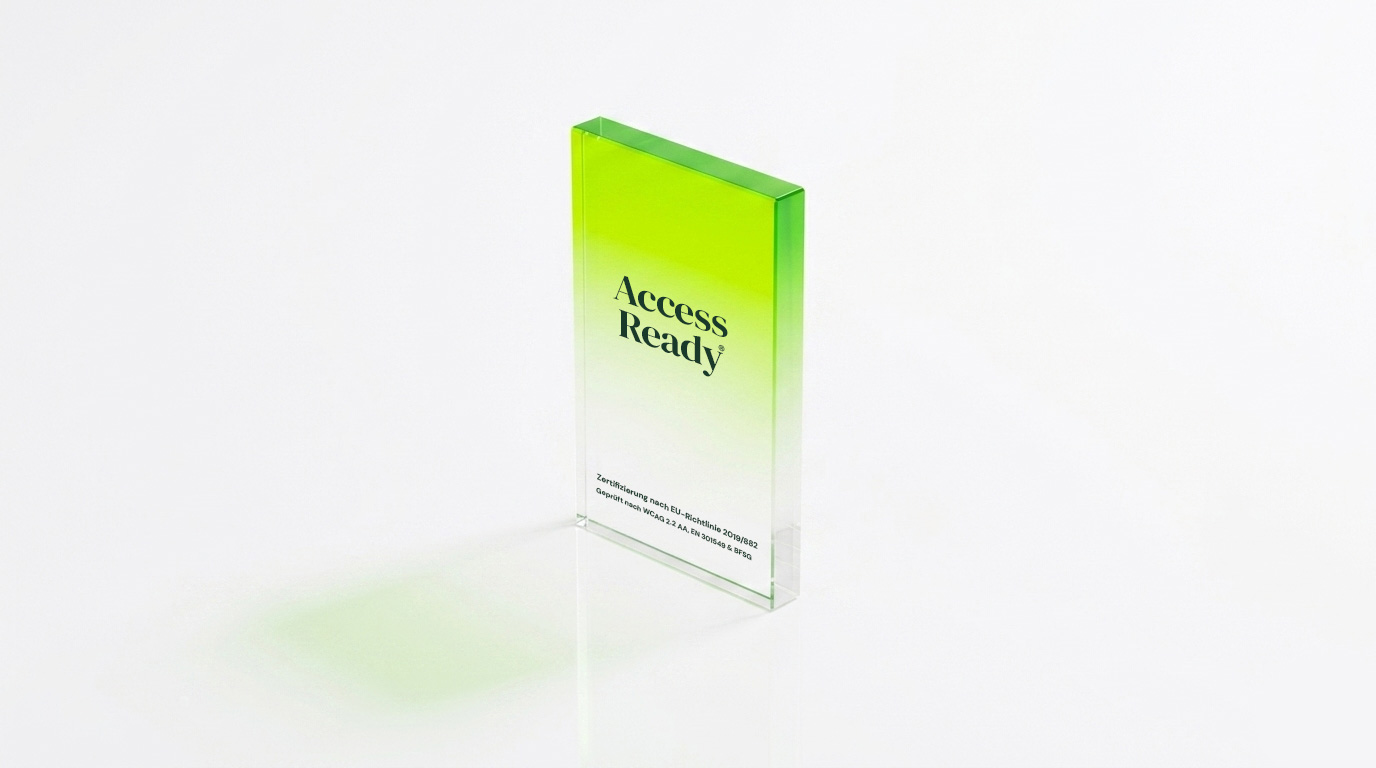
Get started with Access Score®: this free assessment allows you to see, in just a few minutes, where your digital offering currently stands. Access Ready®, our in-depth audit conducted in accordance with EN 301 549 using real users of assistive technologies, documents the result criterion by criterion. Once all issues have been rectified, you will receive the ifdb certificate: it records what was tested, how, and with what result. To ensure that this standard is maintained after every deployment, Access Guard® safeguards it through ongoing monitoring.
And Access Protect® assumes liability under contract for the German BFSG – available only with an Access Ready® certificate and ongoing Access Guard® monitoring. This is the structural advantage it has over any overlay provider – because a script cannot assume liability.
FAQ
Frequently asked questions about the European Accessibility Act
What is the European Accessibility Act, simply explained?
The European Accessibility Act (EAA) is EU Directive 2019/882, which sets out uniform accessibility requirements for a wide range of digital products and services. It is transposed into national law by each Member State and has been in force since 28 June 2025.
What is the difference between EAA and BFSG?
The EAA is the European directive, while the BFSG is its German implementation. The EAA sets out the framework, while the BFSG governs its practical implementation in Germany. In terms of content, both pursue the same objective.
Does the European Accessibility Act also apply to organizations outside the EU?
Yes. It is not the company’s registered office that is decisive, but the market. Anyone offering products or services to consumers in the EU falls within the scope of the EAA – even if they are based outside Europe. The principle is similar to that of the GDPR.
Which products and services does the EAA cover?
These include, among other things, computers, smartphones, e-book readers and self-service terminals, as well as online shops, banking services, telecommunications services, e-books and passenger transport.
Which technical standard applies to EAA compliance?
The EAA refers, through national legislation, to EN 301 549, which in turn is based on the WCAG. The version cited today is based on WCAG 2.1 Level AA; version 4.1.1 adopts WCAG 2.2.
What penalties apply for breaching the EAA?
That depends on the Member State in question. Fines range from a few thousand euros to around one million euros, depending on the Member State. In addition, there may be sales bans and consumer complaints.
How soon do I need to be EAA-compliant?
Since 28 June 2025, new products and services must be compliant from the outset. For existing products and services, a transition period until 28 June 2030 applies in many places.
One market, one standard, one certificate.
The European Accessibility Act establishes a single standard from 27 national sets of regulations – and that is precisely where your opportunity lies. Once you have passed a thorough audit, you have the same technical basis documented for every EU market. Let’s work together to determine how you can achieve this with the least possible effort.
The European Accessibility Act in practice – understanding the European framework, documenting conformity
The European Accessibility Act is the common European framework for digital accessibility and the basis from which national laws such as the BFSG are derived. Anyone wishing to consult the original text of the directive can find it as Directive (EU) 2019/882 on the EUR-Lex portal, while the European Commission sets out the broader context of European accessibility policy on the ‘Shaping Europe’s digital future’ website. Both sources demonstrate that the EAA is not an isolated piece of legislation, but rather part of a long-term European standard.
With ifdb, you can make the transition from the European framework to practical implementation: the free Access Score® compliance scan provides an initial assessment of your current situation; the in-depth audit, accompanied by an ifdb certificate, documents the result criterion by criterion; and Access Protect® assumes liability under contract for the German BFSG, with an Access Ready® certificate and ongoing Access Guard® monitoring. This is how a European obligation becomes a cross-border competitive advantage.