








DIGITAL ACCESSIBILITY · LEGISLATION · EAA · EN 301 549 · WCAG 2.2
BFSG – the Accessibility Strengthening Act and what it means for your business.
The BFSG has turned a voluntary measure into a legal obligation. Since 28 June 2025, many digital products and services in Germany must be accessible – and the first warning letters are already being sent out, even though it remains unclear whether they are legally valid. But what exactly does the Accessibility Enhancement Act require, who is affected, and how do you demonstrate that you are compliant? On this page, we explain the legal situation in clear terms and show you the quickest route from compliance to robust evidence. The free BFSG Check will show you where your website stands today in just a few minutes.
Trusted by leading companies in the DACH region
Appeared as an expert on ZDF WISO







What the BFSG is and why it matters now
The BFSG, which stands for the Accessibility Strengthening Act, is the German implementation of the European Accessibility Act, EU Directive 2019/882. The idea behind it is simple: what has long been taken for granted in the physical world – ramps, lifts, tactile guidance systems – should also apply in the digital world. People with disabilities and older people should be able to use online shops, banking portals and apps without needing assistance from others.
The law was passed back in 2021, but it will not take full effect until 28 June 2025, at which point it will become binding on large sections of the private sector. This marks the end of a long grace period during which accessibility was a voluntary measure for businesses. Today, it is a requirement with clear legal consequences – and the first warning letters show that this obligation is no mere formality – even if the question of whether such warnings are enforceable under Section 3a of the Unfair Competition Act (UWG) has not yet been clarified by the courts.
Is accessibility a requirement for your website? Who is covered by the BFSG?
The key question for every business is: Does this even affect me? The BFSG distinguishes between products and services. Products include, amongst other things, computers, smartphones, e-book readers, self-service terminals and smart TVs. On the services side, we find precisely those digital offerings that most businesses use on a daily basis: online shops, banking services, telecommunications services, e-books, and digital ticketing and booking systems. Anyone offering products or services to consumers through electronic commerce should therefore check carefully whether the law applies.
Ever since the Act came into force, I’ve been asked in almost every initial consultation whether the BFSG also applies to a company’s own website. And I must say, quite honestly, that the answer circulating online is usually either too sweeping (“it applies to everyone”) or too reassuring (“we’re only a small or medium-sized business”). Both are wrong. The truth lies somewhere in between – and it can be answered more quickly with a clear decision tree than most compliance officers realise. The short answer: from 28 June 2025, private companies must ensure that their digital products and services intended for consumers are accessible, but not every website is covered across the board. Accessibility becomes mandatory for your website if three conditions are met: your offering is also aimed at consumers, it falls within the scope of the BFSG, and you are not a micro-enterprise that offers services exclusively. Anyone who meets all three conditions is obliged to comply – with no grace period and no blanket exemption for existing websites.
The decision tree: Are you affected by the website requirement?
If you have fifteen minutes to spare today, please answer these six questions honestly – in this order. Each answer will tell you what to do next.
- Do you offer products or services in Germany via a website, an online shop, an app or a self-service terminal? If not: this does not apply to you. If so: proceed to question 2.
- Is your digital offering also aimed at consumers (B2C)? This includes traditional retail sales to end customers, but also hybrid models in which private individuals are effectively part of the target group – even without dedicated B2C marketing. If no: proceed to question 6. If yes: proceed to question 3. Manufacturers and retailers of payment and self-service terminals should proceed to question 3 in all cases, as these devices ultimately serve consumers, even if they are sold to businesses.
- Does your service fall within the scope of the BFSG catalogue? Specifically: e-commerce, banking, telecommunications, passenger transport, audiovisual media services, e-books, emergency communications or certain hardware (computers, smartphones, terminals, readers). If no: you are not directly affected, but please read question 6 anyway. If yes: proceed to question 4.
- Do you employ ten or more people, or do both your annual turnover and your annual balance sheet total exceed two million euros? To qualify for the exemption, both thresholds must be met simultaneously: fewer than ten employees and an annual turnover or annual balance sheet total of no more than two million euros. If so: you are not a micro-enterprise and are affected; proceed to question 5. If not, and you provide services: you fall under the micro-enterprise exemption. If not, but you manufacture, import or distribute products from the BFSG catalogue: you are still affected in respect of these products, as the exemption applies only to services.
- Did your website or app go live before 28 June 2025? This does not affect the obligation. The BFSG applies to ongoing services; there is no blanket exemption for existing websites. The Act only provides for transitional arrangements for products already in use, for existing contracts and for self-service terminals; see the section on deadlines below for more details. Anyone who has read this far is subject to this obligation.
- Are you a public body (central government, regional governments, local authorities, municipal enterprises, certain bodies with borrowing powers)? If so: As a general rule, the BFSG does not apply to you; instead, the Accessibility Act for public bodies applies – or, for federal bodies, the BITV 2.0, which contains some stricter requirements. If not, and you have so far concluded that you are ‘not affected’: you are indeed not currently obliged to comply – but please read the B2B section below before you dismiss the matter entirely.
In my experience, this tree clearly categorises around 80 per cent of cases. The remaining 20 per cent fall into two grey areas: the micro-enterprise threshold and the B2B/B2C distinction. We’ll now go through these two in detail.
Micro-enterprises: What the exemption actually covers
There is one important exception, which is, however, often misunderstood. Micro-enterprises with fewer than ten employees and an annual turnover or balance sheet total of no more than two million euros are exempt from these obligations – but only in the area of services. Any micro-enterprise that places products on the market is still subject to the BFSG. Many people overlook this distinction and lull themselves into a false sense of security that has no legal basis.
In practice, this exception is the gateway to most of the misjudgements I come across. There are three points you need to understand.
Firstly: Both thresholds apply, simultaneously. You are only considered a micro-enterprise if you employ fewer than ten people AND have an annual turnover of no more than two million euros or an annual balance sheet total of no more than two million euros. If you employ ten or more people, or if both your turnover and balance sheet total exceed these figures, you no longer qualify for the exemption. In audits, I regularly find that managing directors focus on the number of employees and overlook turnover – or vice versa.
Secondly: the term ‘product’ is used in a narrower sense than many people realise. Under the BFSG, ‘products’ refer only to the devices explicitly listed: computers, smartphones, self-service terminals, e-book readers and similar hardware. ‘Services’ are those listed in the catalogue; for most businesses, this primarily means sales and bookings via a website or app. Micro-enterprises that sell e-book readers therefore remain fully subject to the regulations. By contrast, a micro-enterprise operating a purely online shop selling tea falls under the exemption – provided it complies with the thresholds. Tea is not a product within the meaning of the BFSG; the shop is a service.
Thirdly: The BFSG does not expressly stipulate when exceeding the threshold is deemed to have occurred. The definition is based on the European Commission’s SME Recommendation. Under that framework, a company’s status only changes if it exceeds or falls below the thresholds in two consecutive financial years, measured against the most recent completed financial year. This grace period prevents annual fluctuations in classification. It remains to be seen whether the Market Surveillance Authority will apply the same approach at the BFSG. You should therefore not rely on this: any start-up that is just about to cross the threshold should start actively preparing from that point onwards, rather than being caught off guard two years later. In my practice, I regularly see this transition point, particularly with growing D2C brands – and it almost always comes sooner than the founders realise.
There is no SME exemption
One particular misconception is particularly common in relation to the BFSG: that small and medium-sized enterprises are, as a rule, exempt. This is not true. The law only recognises an exemption for micro-enterprises, and this is significantly narrower than the term ‘SME’. According to the EU definition, a company with fewer than 250 employees is still classified as an SME. By contrast, only service providers with fewer than ten employees and an annual turnover or balance sheet total of no more than two million euros are exempt from the BFSG.
For small and medium-sized enterprises, this means that an online retailer with 25 employees is subject to the same obligations as a large corporation. The requirements for the website are the same; it’s just that the approach is different because budgets and resources are limited. I’ll explain below how to deal with this effectively.
B2B or B2C: the question that’s often answered incorrectly
The seemingly clear distinction – ‘we do B2B, so we’re not affected’ – is the second major grey area when it comes to the website requirement. Pure B2B is indeed not covered by the BFSG. But ‘pure’ B2B is less common than most managing directors think. In my audit practice, I repeatedly come across three hybrid models.
Firstly, the open product catalogue: a B2B manufacturer publishes data sheets, tutorials and configurators publicly on its website. Members of the public can access this content without logging in – and they do. The situation becomes problematic as soon as the configurator culminates in an order or booking that consumers can also complete. In that case, the offer is, in effect, also aimed at consumers.
Secondly, the parallel B2C arm of the business: a company sells 95 per cent of its products to resellers and, on the side, conducts a small amount of direct sales to end customers. The five per cent is sufficient for the BFSG to apply, because the service of ‘online sales to consumers’ is in fact being provided.
Thirdly, the open platform: a B2B SaaS provider allows private individuals to use its service free of charge on a trial basis. As soon as consumers are able to access the service, the BFSG generally applies – even if this has never been actively advertised.
The only clear-cut test: do not ask yourself ‘who do we want to sell to’, but rather ‘who, in practice, can purchase our service as a consumer’. This is the criterion that the law – and, in the event of a dispute, the market surveillance authority – will apply. If you cannot unequivocally reduce the answer to ‘nobody’, you fall within the scope of the legislation. A technical restriction exclusively for business customers (login with business licence verification, verified onboarding process) is the only measure that works reliably in this context.
The crucial click: when your website becomes a service
For SMEs, tradespeople and service providers, one question is in any case more important than the size of the business: is a contract with consumers concluded on your website, or is the website designed to facilitate this? The BFSG covers so-called services in electronic commerce – that is, offers made via a website or app that are aimed at concluding a consumer contract. A purely informational website on which you present your business, your services and your contact details is, according to the prevailing view, not covered by this definition.
For small and medium-sized enterprises, this means that an online retailer with 25 employees is subject to the same obligations as a large corporation. The requirements for the website are the same; it is simply that the path to compliance looks different because budgets and resources are limited. I’ll show you below how to manage this wisely. You can find the key dates in our overview of digital accessibility deadlines.
The crucial click: when your website becomes a service
For SMEs, tradespeople and service providers, one question is in any case more important than the size of the business: is a contract with consumers concluded on your website, or is the website designed to facilitate this? The BFSG covers so-called services in electronic commerce – that is, offers made via a website or app that are aimed at concluding a consumer contract. A purely informational website on which you present your business, your services and your contact details is, according to the prevailing view, not covered by this definition.
Practical tip: Take a look at the last button in your ordering or booking process. If it says ‘place an order subject to payment’ or ‘book subject to a charge’, you are entering into a contract with consumers online – § 312j of the German Civil Code (BGB) specifically requires this wording for precisely this scenario. In that case, you fall within the scope of the German Distance Selling Act (BFSG), provided you are not a micro-enterprise. Conversely, however, this does not automatically apply, as even a free registration can give rise to a consumer contract.
Contact form and appointment booking: even professional bodies and associations are divided on this issue
Things get a bit tricky when it comes to contact forms and appointment bookings. The German Confederation of Skilled Crafts (ZDH) takes the view that contact forms are generally not covered, as they are intended solely for making initial contact. It takes a different view, however, if a form is clearly designed to lead to the direct conclusion of a contract. Some Chambers of Industry and Commerce, on the other hand, explicitly cite contact forms as an example of functions that are affected.
When it comes to booking appointments online, the situation is somewhat clearer. The ZDH considers such bookings to be covered if the booking process includes a payment option, and regards this as entirely justifiable even if payment is only made on arrival. The guidelines issued by the Federal Ministry of Labour address precisely this scenario as a separate example. My advice, therefore, is this: if a form or booking tool is central to your business, treat it as if it were covered by the regulations. An accessible form costs very little – a dispute over whether it should have been accessible costs considerably more.
Skilled trades: When a business is affected
Many craft businesses fall under the micro-enterprise exemption simply because of their size, at least as long as they provide services. Things get interesting for businesses with ten or more employees, or with a turnover and balance sheet total of more than two million euros. For them, everything hinges on what actually happens on the website:
- A simple presentation of services, references and contact details: generally not affected.
- Enquiry form for a quote: subject to debate; if in doubt, design it to be accessible.
- Online appointment booking, for example for hairdressers, garages or opticians: generally affected, particularly if it includes a payment function.
- Online shop for spare parts, accessories or baked goods: affected.
Businesses with multiple branches, in particular, often use external booking or shop systems. Whilst the technical implementation is the responsibility of the provider, the responsibility for the service offered to your customers usually lies with you. You should therefore ask for proof that the tool is accessible before integrating it.
Service providers: from driving schools to gyms
The same logic applies to service providers. A coach who only books appointments by telephone is not affected. A driving school with twelve employees, where you have to register online to secure a place, most likely is. The same applies to gyms with online membership, language schools with course booking, event organisers selling tickets, or online academies where courses are purchased directly.
Agencies, tax advisers or IT service providers that work exclusively for businesses are not covered by the BFSG as they operate purely in the B2B sector. For agencies, however, the issue is far from settled, as their clients are affected and expect websites that meet the requirements. Anyone who delivers an online shop or booking tool today that lacks digital accessibility risks facing demands for rectification – at the very latest when accessibility is specified in the contract.
Public bodies: Why the BFSG does not usually apply to them
Public authorities, local authorities, municipal enterprises and certain bodies entrusted with public tasks are generally not covered by the BFSG, but by the accessibility legislation applicable to public bodies: federal bodies are subject to the Disability Equality Act and the BITV 2.0, whilst the federal states and local authorities are subject to their respective state laws. The BITV 2.0 is stricter in some respects: it requires additional information in plain language and German Sign Language on the homepage and does not provide for a micro-enterprise exemption. Instead of the mandatory information under the BFSG, public bodies must publish an accessibility statement with a feedback mechanism and a link to the conciliation body. Anyone working in a mixed-structure organisation – such as a local authority-owned limited company with commercial operations – must assess both sets of regulations in parallel. I frequently encounter this situation in municipal utilities, transport companies and local authority housing associations.
SMEs in B2B: Where the obligation creeps in through the back door
Even those who are not legally affected are becoming increasingly aware of the issue. Under Section 121(2) of the German Act against Restraints of Competition (GWB), public contracting authorities must include accessibility criteria in their service specifications if the service being procured is intended for use by natural persons; they must provide justification for any exceptions. Anyone supplying software, portals or digital services to public authorities, local authorities or municipal utilities therefore needs robust evidence.
Added to this are large companies which are themselves subject to the BFSG and pass on the requirements to their suppliers – for example, for integrated booking, payment or chat systems. For many small and medium-sized enterprises, digital accessibility is therefore less a question of obligation than a question of whether they can continue to compete in tenders and supply chains.
Fundamental change and disproportionate burden: the little-known exceptions
In addition to the micro-enterprise rule, the BFSG provides for two further exemptions which hardly anyone makes use of – and for good reason. Companies may invoke these exemptions if the requirements would fundamentally alter a product or service (Section 16 BFSG) or would impose a disproportionate burden (Section 17 BFSG). To do so, however, they must carry out an assessment – in the case of a disproportionate burden, in accordance with the criteria set out in Annex 4 of the BFSG – document it, retain the records for five years and inform the market surveillance authority.
In practice, this is a fine line to tread. The assessment must clearly demonstrate that the costs would be disproportionately high in relation to the benefits for people with disabilities. For most websites, it is simply cheaper to make the key processes accessible than to provide a sound justification for this exception.
What technical requirements does the BFSG impose?
The Act itself does not set out the specific technical standard. The requirements are set out in the associated Regulation (BFSGV), and Section 4 of the BFSG establishes a presumption of conformity with harmonised European standards. However, under the European Accessibility Act, no standard has yet been specified in the Official Journal of the European Union, and the BFSG itself does not specify a version of the WCAG. In practice, therefore, EN 301 549 serves as the standard, which in turn is based on the WCAG: its version V3.2.1 corresponds to WCAG 2.1 at Level AA and is harmonised under the EU Directive on the websites of public sector bodies. The successor version, V4.1.1, based on WCAG 2.2 AA, was published by ETSI on 2 September 2026; it has yet to be listed in the Official Journal. For digital services, this means that a website or app must be perceivable, operable, understandable and robust – the four fundamental principles of accessible design. These include sufficient contrast, full keyboard navigation, meaningful alternative text, a logical structure and seamless integration with assistive technologies such as screen readers.
Added to this is a formal obligation that is often underestimated: under Section 14 and Annex 3 of the BFSG, service providers must provide transparent information on how their services meet accessibility requirements – either in their general terms and conditions or in some other clearly visible manner, which must itself be accessible and include details of the relevant market surveillance authority. The BFSG does not recognise the term ‘accessibility statement’, even though it is often used in everyday language to refer to this mandatory information.
What are the risks of non-compliance?
The consequences are not a theoretical construct, but are already a reality. The market surveillance authority – in Germany, the State Market Surveillance Authority for the Accessibility of Products and Services (MLBF) in Magdeburg – can impose fines of up to 100,000 euros, or up to 10,000 euros for other offences depending on the nature of the breach, remove non-compliant products and services from the market, and compel providers to rectify the situation. The MLBF has had full jurisdiction since 26 September 2025 and also carries out random checks without there being any specific cause. Added to this is a second, often underestimated front: warnings under competition law issued by competitors and trade associations. Such warnings have been sent out since the summer of 2025, although it remains unclear whether breaches of the BFSG under Section 3a of the Unfair Competition Act (UWG) can be subject to warnings at all; there is no published court ruling on this matter. This creates a dual risk for companies arising from regulatory sanctions and disputes under private law – and in both cases, reputational damage that is far more difficult to quantify than any fine.
I have set out in detail what happens if you do receive a warning letter and how you can protect yourself in the guide ‘Warning letters for lack of accessibility: a real risk and how to protect yourself’.
What my audit practice has shown since June 2025
Since the website requirement came into force, the MLBF has been significantly more active than many had expected. The complaints I’ve encountered in client projects mainly fall into three categories:
- Medium-sized e-commerce providers who relied on an existing accessibility toolbar and were surprised to find that it was not accepted as proof of compliance.
- Banks and financial service providers whose banking apps may look modern, but fail time and again when used with a screen reader or keyboard.
- Insurance companies and energy suppliers whose digital application processes are advertised as being accessible, but whose contract PDFs are ultimately inaccessible.
So the critical points are not always where marketing and management expect them to be. They lie deep within the conversion paths and in the documents at the end of the customer journey.
Deadlines, transitional arrangements and time pressure
The BFSG applies, in principle, to all products and services that are newly launched on the market or provided from 28 June 2025 onwards. For existing offers, Section 38 of the BFSG provides for three transitional rules: a service provider may continue to use products that they lawfully used for their services prior to 28 June 2025 until 27 June 2030. Contracts for services concluded before 28 June 2025 may remain in force until their expiry, but no later than 27 June 2030. Self-service terminals may continue to be operated until the end of their economic useful life, but for no longer than 15 years after they were first put into service. As regards the website itself, the prevailing view is that there is no blanket grandfathering provision: Anyone entering into contracts with consumers via the website today must comply with the requirements today. These deadlines create a temptation to put off addressing the issue. This is risky, as accessibility cannot be achieved overnight. A thorough audit, the rectification of deficiencies and the development of in-house expertise all require lead time. Those who view the remaining time as a buffer rather than a delay will have a clear advantage.
You can find full details of all the deadlines in our overview of digital accessibility deadlines. Incidentally, the amendment to the BFSGV due in July 2026 applies only to self-service terminals and emergency calls, not to the requirements for websites.
How SMEs can tackle the website requirement on a limited budget
With a limited budget, the order in which you proceed is key. These steps have proven effective:
- Use the decision tree above to determine whether you are affected, and record the result in writing.
- Get an initial overview of your website with the free Access Score®.
- Focus first on the processes involved in concluding a contract: shopping basket, booking, login and payment.
- Check any integrated third-party systems, such as shop, booking or payment tools, and request evidence of compliance.
- Provide the mandatory information on accessibility – often referred to as an ‘accessibility statement’ – and describe the current situation in it.
- Have the critical processes tested by real users using Access Ready, and then verify the status using Access Guard.
This way, you invest first in areas where there is risk and turnover, rather than in pages that hardly anyone visits anyway. Anyone wishing to fund the implementation can find an overview of the current federal and state funding schemes for digital accessibility.
The decision tree above clarifies the legal applicability. What it does not clarify is how wide the actual gap is between your current status and the legal requirements. An audit answers this question. The Access Score® provides the quickest initial, honest assessment: a free, automated scan of your domain that shows you, within a few minutes, where your website stands from a technical perspective and which errors take priority. As 60 to 70 per cent of the WCAG criteria cannot be checked automatically, it is no substitute for an in-depth audit when it comes to providing robust evidence. However, it does provide you with the basis for deciding whether you should take further action and, if so, how urgently.
From the obligation to ensure safety.
How to ensure you comply with the BFSG and continue to do so.
Simply knowing that an obligation exists does not protect you from its consequences. What does protect you is a verifiable, documented record of compliance – and, in the event of an emergency, someone who will stand up for you. That is exactly what the Access Suite is designed for.
Missing an accessibility statement? With Access Declare, you can create your own accessibility statement – free of charge for a domain with up to 150 pages, and based on a genuine audit rather than a template.
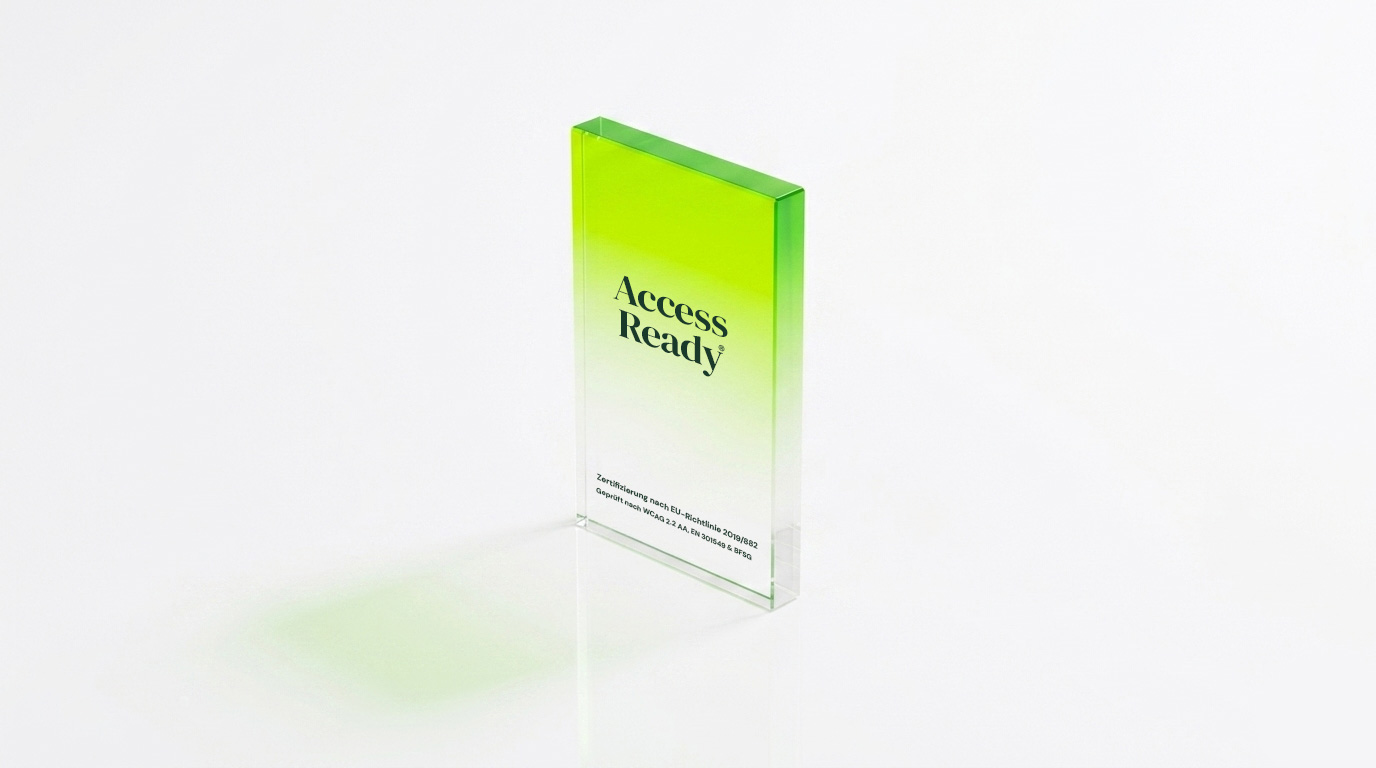
Access Score® is the first step: with the free BFSG Check, you can assess your website in just a few minutes and see where you stand today. Access Ready®, our in-depth audit in accordance with EN 301 549, carried out with real users of assistive technologies, provides legally valid proof. Once all issues have been rectified, you will receive the legally valid ifdb certificate as proof of your due diligence. To ensure that this standard is maintained even after every website update, Access Guard® safeguards it through ongoing monitoring.
And just in case the worst comes to the worst, there’s Access Protect®: contractual liability cover in the event of BFSG warning letters, with an Access-Ready certificate and Access Guard active. Should a BFSG lawsuit arise, ifdb experts and partner law firms will handle the case. That is the key difference compared to any overlay provider – because a script cannot assume liability.
FAQ
Frequently asked questions about the BFSG
What is the BFSG, simply explained?
The BFSG, the Accessibility Strengthening Act, is a German law that imposes accessibility requirements on certain digital products and services. It transposes the European Accessibility Act into national law and has been in force since 28 June 2025.
Since when has the BFSG been in force?
The Act was passed in 2021 and has been in force since 28 June 2025. Transitional provisions apply only to products already in use, to existing contracts (until 27 June 2030 at the latest) and to self-service terminals (for a maximum of 15 years after they are put into service).
Who is affected by the BFSG?
This applies to manufacturers, retailers and importers of certain products, as well as providers of digital services to consumers – such as online shops, banks, telecoms providers and booking portals. The decisive factor is whether you offer such products or services to consumers.
Does the exemption for micro-enterprises also apply to my online shop?
Yes, if you have fewer than ten employees and your annual turnover or balance sheet total does not exceed two million euros. The online shop is a service, and the exemption applies only to that. However, if you manufacture or sell products from the BFSG catalogue – such as computers, smartphones or e-book readers – the BFSG still applies to those products.
What penalties apply for breaching the BFSG?
Fines of up to 100,000 euros may be imposed, and market surveillance authorities may prohibit the offer. In addition, warnings are issued by competitors and trade associations; whether breaches of the BFSG can be challenged under competition law has not yet been clarified by the courts.
How do you make a website compliant with BFSG regulations?
The BFSG does not specify a WCAG version, and no standard has yet been listed in the Official Journal of the European Union under the EAA. In practice, EN 301 549 (V3.2.1, corresponding to WCAG 2.1 AA) is regarded as the benchmark. A website must be perceivable, operable, understandable and robust; service providers must also make the mandatory information set out in Annex 3 of the BFSG available. The most reliable approach involves conducting an audit, rectifying any deficiencies and providing documented evidence.
Is an accessibility widget sufficient to ensure compliance with the BFSG?
No. An overlay or widget may improve the user experience, but it does not remove barriers in the code and is no substitute for robust evidence. Compliance is achieved at the code level and is demonstrated by an audit, not by a script added retrospectively.
Turning an obligation
into an advantage.
The BFSG makes action a necessity – but those who act early gain more than just legal certainty: better user experiences, greater reach and a stronger brand image. Let’s work together to clarify whether and how the Accessibility Strengthening Act affects you, and which path to compliance is most efficient for you.
BFSG in practice – understanding the legal framework, ensuring compliance
The BFSG has transformed digital accessibility in Germany from a voluntary measure into a legal requirement. Anyone wishing to consult the original legal text will find a comprehensive official interpretation at the Federal Centre of Expertise on Accessibility, whilst the underlying European Accessibility Act sets out the European framework from which the Accessibility Strengthening Act was derived. Both sources demonstrate that this is not a temporary regulation, but a permanent standard.
With ifdb, you can make the transition from legal compliance to practical compliance: the free BFSG Check from Access Score® provides an initial assessment of your current situation; the in-depth audit, complete with an ifdb certificate, delivers robust evidence; and in the event of warnings under the BFSG, Access Protect® contractually assumes liability. In this way, a legal obligation is transformed into a robust competitive advantage.