







Revenue calculator · Conversion rate · Checkout abandonment · Digital accessibility
Calculate your conversion rate – and see what barriers cost you.
Your conversion rate shows how many visitors buy. It does not show how many tried and failed at an unlabelled form field, a button without a name or a checkout that cannot be used with a keyboard. The ifdb revenue calculator closes this gap: it checks your website automatically, calculates your conversion rate and earnings per visitor from your key figures, and shows the order of magnitude of revenue that is lost today due to missing digital accessibility. Free of charge, in a few minutes and with disclosed assumptions.
Trusted by leading companies in the DACH region
Featured as an expert on ZDF WISO











The metric
that no dashboard
shows.
Cart abandonment, loading times, click paths: online retailers and digital managers adjust every lever. One cause of abandoned purchases does not appear in any analytics report: people who cannot fully use your website. Their abandonment looks like any other bounce and therefore remains unexplained.
How widespread this is was shown by a Civey survey commissioned by AccessiWay among 2,500 consumers: 80.7 percent have already abandoned at least one digital process because of a lack of digital accessibility. Among 50- to 64-year-olds, the figure was 84.3 percent.
The revenue calculator translates these abandonments into the language of your controlling: lost conversions, lost earnings and customers you can additionally reach.
Step 1 · Your website
Automated check
The findings come first
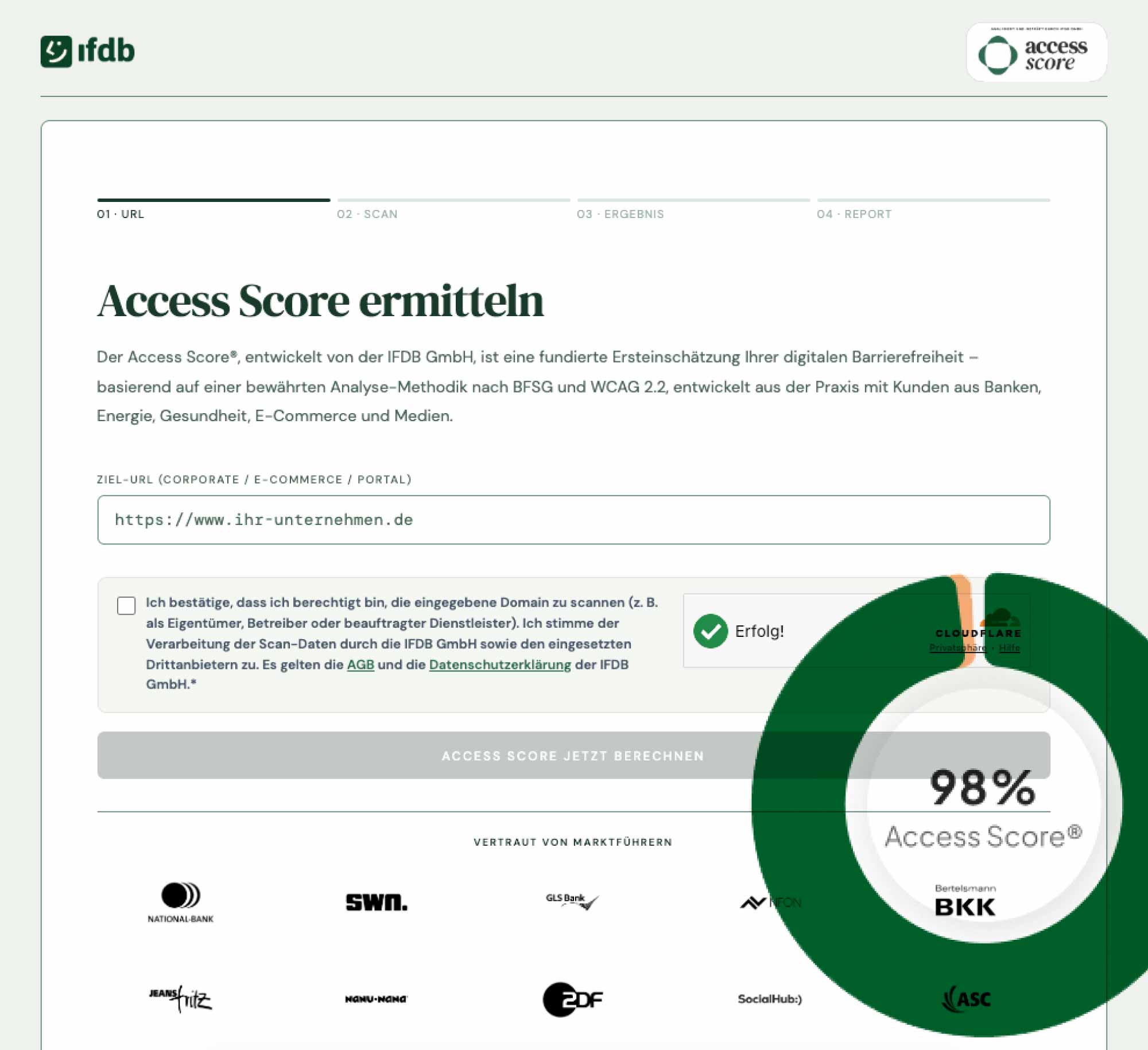
You enter your website address and the Access Score® checks the site against WCAG 2.2. What matters is where a barrier sits: a missing alternative text on the home page weighs less than an unlabelled required field in the checkout. A figure only emerges from this classification, never the other way round.
Step 2 · Your figures
Your real conversion rate
Calculated with what you sell
From visitors, online revenue or new contracts, the calculator works out your conversion rate and your earnings per visitor. Only the share of people abandoning who would actually have bought at your conversion rate counts as lost. A plausibility check flags it when periods do not match or sessions were entered instead of people.

Step 3 · Your result
A range instead of a claim
Reliable because calculated cautiously
With your key figures and your email address, you receive the full result: what share of your revenue depends on barriers, how many conversions are missing today, what earnings are lost as a result, how many people you can additionally reach and from when an improvement becomes visible. Every figure carries its source, every assumption is stated.

For every industry with online conversions
One calculation logic,
matched to your business model.
Online shops and marketplaces
The calculation is based on the shopping cart: revenue, order value, visitors. The topic particularly affects online shops: according to WebAIM Million 2026, shopping sites have an average of 71 errors per home page, compared with 56 on average across all pages examined. More about the accessible online shop.
Energy and telecommunications
Tariff calculator, contract conclusion, customer portal: what counts here is the contribution margin over the entire contract term. The calculator reports the result as the value of new business, not as annual revenue, so that nobody plans with the wrong figures. More about the customer portal for utilities and the service portal in telecommunications.
Banks and financial service providers
Account opening, loan application, securities account: application journeys are long and form-heavy, and every barrier in them costs a conversion. The calculation is based on the earnings per contract. More about accessible online banking.
Media, streaming and publishing
Trial subscription, paywall, cancellation journey: what counts here is the subscription value. Subscriptions depend on a smooth sign-up, including for people who use your content with a screen reader or only with a keyboard. More about accessible videos and media.
Online courses and e-learning
If you sell courses online, the calculation works like a shop: based on the course price and the number of bookings. Barriers hit twice here, when buying and later in the course itself. More about the accessible learning platform.
Healthcare and health insurers
Membership, switching insurer, online service centre: the calculation is based on the value per member. Because customers here are often older, the calculator explicitly takes the age structure of your target group into account. More about the accessible patient portal.
How much revenue is left on the table on your website?
A few details, an automated check, and you know what order of magnitude we are talking about. Free of charge, without obligation and with a method you can follow at every step.
FAQ
Frequently asked questions about the revenue calculator
1. How do I calculate my conversion rate?
Divide the number of conversions by the number of visitors in the same period and multiply the result by 100. An online shop with 2,394 orders from 120,000 visitors per month has a conversion rate of 2.0 percent. The revenue calculator does this calculation for you and also shows the earnings per visitor.
2. What details does the calculator need?
Your website address, your industry and your online revenue or number of new contracts, optionally your visitors per month. In addition, a rough estimate of whether your customers are younger, average or older than the general population, and your email address. If you do not know your average order value, the calculator uses 146.19 euros, the average in German online retail in 2025 according to bevh and EHI.
3. How accurate is the result?
It is an estimate with disclosed assumptions, not a promise. That is why you receive a range instead of a single value. Where sources are missing or come from other countries, we apply explicit safety discounts. Every assumption is stated in the detailed report.
4. Does every abandonment count as a lost customer?
No. Of the people who fail at a barrier, only the share that would have bought anyway at your actual conversion rate counts as a loss. This avoids inflated figures, even with a low conversion rate.
5. What do barriers have to do with abandoned purchases?
More than most people expect. According to WebAIM Million 2026, labels on form fields are missing on every second home page, and a third of all form fields are not labelled correctly. People who have the screen read aloud do not find out which information belongs in which field, and abandon the purchase.
6. When does an improvement take effect?
In the checkout, every barrier removed takes effect from go-live. In organic visibility, the effect usually shows after one to three months. How long it takes until the effect can be demonstrated in your own figures is calculated by the calculator based on your visitor numbers.
7. Is the revenue calculator free of charge?
Yes. You enter your website, your key figures and your email address and receive the full result with all figures and sources. There are no costs and no obligation.
How the revenue calculator works: method and sources
The calculation follows a fixed chain. The starting point is your visitors. Some of them live with a permanent impairment: at least 9.4 percent according to the official statistics of the German Federal Statistical Office, up to 23.9 percent according to the European survey EU-SILC 2024, each adjusted to the age structure of your customers. From this, the calculator determines how many people are significantly held back by the findings, how many of them abandon and how many of them would actually have bought at your conversion rate. Multiplied by your value per conversion, this gives the lost earnings. On top of this comes a deliberately small effect for all users, because a smooth checkout helps everyone. It is many times lower than the good 35 percent more conversions that the Baymard Institute cites for an overall better-designed checkout.
A worked example: an online shop with 350,000 euros monthly revenue, 120,000 visitors and an order value of 146.19 euros has a conversion rate of 2.0 percent. If the findings affect the form journey and the customers match the population average, the potential lies between 1.47 and 5.30 percent of revenue, i.e. between around 62,000 and 223,000 euros a year.
We disclose the limits. The abandonment rate comes from a British survey from 2019; we apply discounts of 20 to 40 percent to it. There is no study on the effect of a single type of error; this classification is an assumption by ifdb. That is why the calculator gives a range and not a promise. The model is based on data for Germany and the EU. The error frequency by industry comes from the WebAIM Million 2026, the figures on abandoned purchases from a Civey survey for AccessiWay (in German).
Where your website stands in detail is shown by the free initial analysis with the Access Score®. Why digital accessibility pays off beyond revenue is explained under the benefits of digital accessibility. If you want to fix and document the barriers found, the certified in-depth audit is the next step.