







DIGITAL ACCESSIBILITY · LEGISLATION · EAA · EN 301 549 · WCAG 2.2
BFSG – the Accessibility Strengthening Act and what it means for your business.
The BFSG has turned a voluntary measure into a legal obligation. Since 28 June 2025, many digital products and services in Germany must be accessible – and the first warning letters show that breaches are being rigorously pursued. But what exactly does the Accessibility Strengthening Act require, who is affected, and how do you demonstrate that you are compliant? On this page, we explain the legal situation in clear terms and show you the quickest route from compliance to robust evidence.
Trusted by leading companies across the DACH region
Featured as an expert on ZDF WISO











What the BFSG is and why it matters now
The BFSG, which stands for the Accessibility Strengthening Act, is the German implementation of the European Accessibility Act, EU Directive 2019/882. The idea behind it is simple: what has long been taken for granted in the physical world – ramps, lifts, tactile guidance systems – should also apply in the digital world. People with disabilities and older people should be able to use online shops, banking portals and apps without needing assistance from others.
The law was passed back in 2021, but it has only come into full effect since 28 June 2025, placing obligations on large sections of the private sector. This marks the end of a long grace period during which accessibility was a voluntary measure for businesses. Today, it is a requirement with clear legal consequences – and the first documented warnings show that this obligation is no longer a mere formality.
Who is covered by the Accessibility Strengthening Act
The key question for every business is: Does this even affect me? The BFSG distinguishes between products and services. Products include, amongst other things, computers, smartphones, e-book readers, self-service terminals and smart TVs. On the services side, we find precisely those digital offerings that most businesses use on a daily basis: online shops, banking services, telecommunications services, e-books, and digital ticketing and booking systems. Anyone offering products or services to consumers through electronic commerce should therefore check carefully whether the law applies.
There is one important exception, which is, however, often misunderstood. Micro-enterprises with fewer than ten employees and an annual turnover of no more than two million euros are exempt from these obligations – but only in the services sector. Any micro-enterprise that places products on the market is nevertheless subject to the BFSG. Many people overlook this distinction and feel a sense of security that has no legal basis.
What technical requirements does the BFSG impose?
The Act itself does not set out the specific technical standard, but refers to the harmonised European standard EN 301 549, which in turn is based on the WCAG. For digital services, this means that a website or app must be perceivable, operable, understandable and robust – the four fundamental principles of accessible design. This includes sufficient contrast, full keyboard control, meaningful alternative text, a logical structure and seamless integration with assistive technologies such as screen readers. In addition, there is a formal obligation that is often underestimated: providers must provide an accessibility statement that transparently informs users about the current state of accessibility.
What are the risks of non-compliance?
The consequences are not a theoretical construct, but are already a reality. Market surveillance authorities can impose fines of up to 100,000 euros, remove non-compliant products and services from the market, and compel suppliers to rectify the situation. Added to this is a second, often underestimated front: warnings under competition law issued by competitors and trade associations. It is precisely here that the first waves of such warnings have been documented since the summer of 2025. This creates a dual risk for companies, arising from both regulatory sanctions and disputes under private law – and in both cases, reputational damage that is far more difficult to quantify than any fine.
Deadlines, transitional arrangements and time pressure
The BFSG generally applies to all products and services that are newly launched or provided since 28 June 2025. For existing offerings, the regulations provide for transitional periods in some cases, which, depending on the circumstances, extend until 28 June 2030, and even beyond that date for certain self-service terminals. These deadlines may tempt organisations to put off addressing the issue. This is risky, as accessibility cannot be achieved overnight. A thorough audit, rectifying any shortcomings and building up in-house expertise all require lead time. Those who view the remaining time as a buffer rather than a delay will have a clear advantage.
From the obligation to ensure safety.
How to ensure you comply with the BFSG and continue to do so.
Simply knowing that an obligation exists does not protect you from its consequences. What does protect you is a verifiable, documented record of compliance – and, in the event of an emergency, someone who will stand up for you. That is exactly what the Access Suite is designed for.
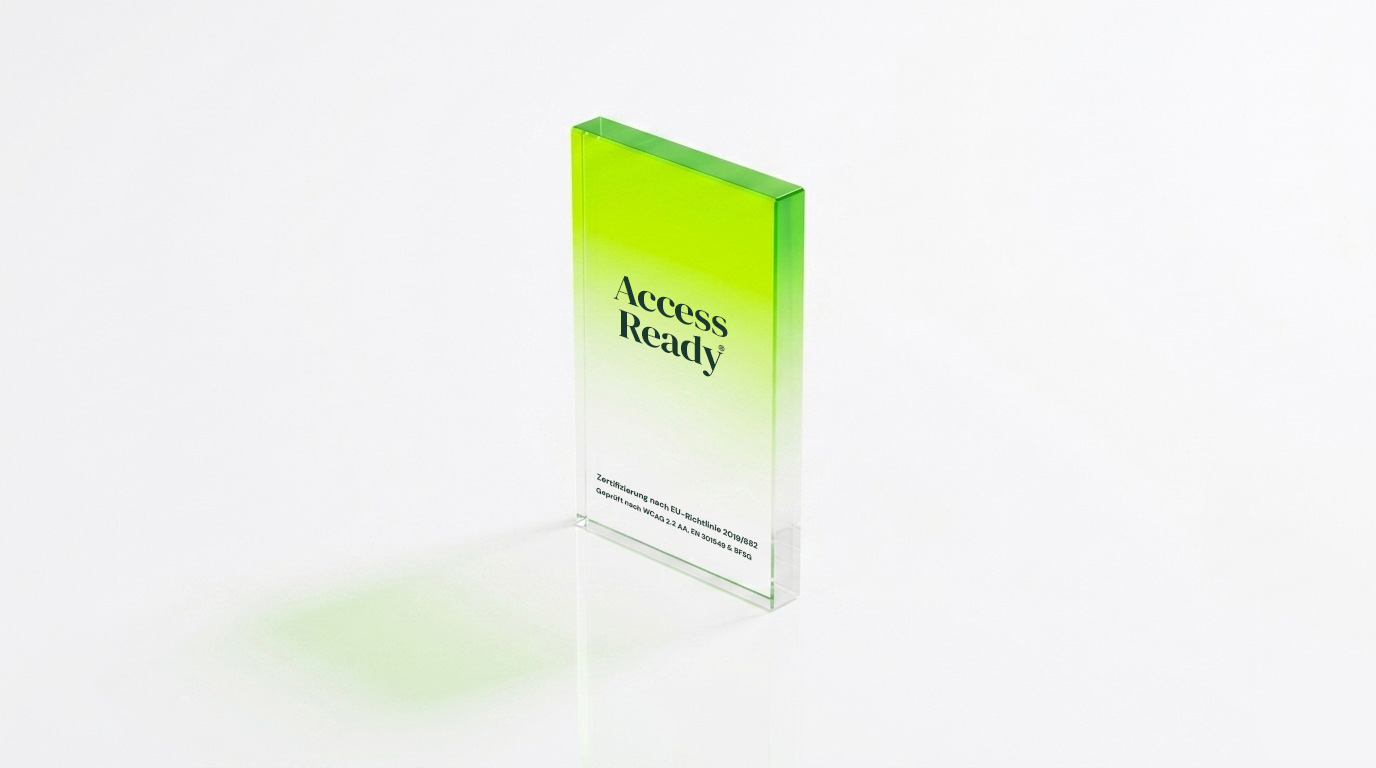
Access Score® is the first step: with the free BFSG Check, you can assess your website in just a few minutes and see where you stand today. Access Ready®, our in-depth audit in accordance with EN 301 549, carried out with real users of assistive technologies, provides legally valid proof. Once all issues have been rectified, you will receive the legally valid ifdb certificate as proof of your due diligence. To ensure that this standard is maintained even after every website update, Access Guard® safeguards it through ongoing monitoring.
And just in case, there’s Access Protect®: contractual protection against warning letters with liability coverage. Should a BFSG claim arise, ifdb experts and partner law firms will handle the case. This is the key difference compared to any overlay provider – because a script cannot assume liability.
FAQ
Frequently asked questions about the BFSG
What is the BFSG, simply explained?
The BFSG, the Accessibility Strengthening Act, is a German law that imposes accessibility requirements on certain digital products and services. It transposes the European Accessibility Act into national law and has been in force since 28 June 2025.
Since when has the BFSG been in force?
The Act was passed in 2021 and has been in force since 28 June 2025. For existing services, transitional periods apply in some cases until 28 June 2030; for certain self-service terminals, these periods are in some cases longer.
Who is affected by the BFSG?
This applies to manufacturers, retailers and importers of certain products, as well as providers of digital services to consumers – such as online shops, banks, telecoms providers and booking portals. The decisive factor is whether you offer such products or services to consumers.
Does the exemption for micro-enterprises also apply to my online shop?
Micro-enterprises with fewer than ten employees and an annual turnover of no more than two million euros are exempt only in the services sector. Anyone who places products on the market is subject to the BFSG, regardless of their size. There is no blanket exemption.
What penalties apply for breaching the BFSG?
Fines of up to 100,000 euros, a ban on the service, and warnings under competition law from competitors and trade associations are all possible. The first waves of warnings have been documented since the summer of 2025.
How do you make a website compliant with BFSG regulations?
The technical standard is EN 301 549 in conjunction with the WCAG. A website must be perceivable, operable, understandable and robust, and must provide a statement of accessibility. The most reliable approach involves carrying out an audit, rectifying any shortcomings and providing documented evidence.
Is an accessibility widget sufficient to ensure compliance with the BFSG?
No. An overlay or widget may improve the user experience, but it does not remove barriers in the code and is no substitute for robust evidence. Compliance is achieved at the code level and is demonstrated by an audit, not by a script added retrospectively.
Turning an obligation
into an advantage.
The BFSG makes action a necessity – but those who act early gain more than just legal certainty: better user experiences, greater reach and a stronger brand image. Let’s work together to clarify whether and how the Accessibility Strengthening Act affects you, and which path to compliance is most efficient for you.
BFSG in practice – understanding the legal framework, ensuring compliance
The BFSG has transformed digital accessibility in Germany from a voluntary measure into a legal requirement. Anyone wishing to consult the original legal text will find a comprehensive official interpretation at the Federal Centre of Expertise on Accessibility, whilst the underlying European Accessibility Act sets out the European framework from which the Accessibility Strengthening Act was derived. Both sources demonstrate that this is not a temporary regulation, but a permanent standard.
With ifdb, you can make the transition from legal compliance to practical compliance: the free BFSG Check from Access Score® provides an initial assessment of your current situation; the in-depth audit, complete with an ifdb certificate, provides robust evidence; and the contractual warning protection offered by Access Protect® safeguards you against the real risk of receiving a warning letter. This is how a legal obligation is transformed into a solid competitive advantage.