






DIGITAL ACCESSIBILITY · EU DIRECTIVE · BFSG · EN 301 549 · WCAG 2.2
European Accessibility Act – the EU Directive that makes accessibility mandatory across Europe.
The European Accessibility Act forms the European framework upon which national laws, such as the German BFSG, are based. Since 28 June 2025, uniform accessibility requirements for many digital products and services have applied across the EU. Anyone offering products or services to consumers in Europe is affected – regardless of where the company is based. On this page, we explain in simple terms what the EAA requires, how it relates to the BFSG and EN 301 549, and how you can achieve Europe-wide compliance with a single, robust certificate.
Trusted by leading companies across the DACH region
Featured as an expert on ZDF WISO










What the European Accessibility Act is and why it affects the whole of Europe
The European Accessibility Act, or EAA for short, is EU Directive 2019/882, which was adopted in April 2019. Its aim is to harmonise the accessibility rules of the Member States, which until then had varied considerably. Instead of 27 disparate national systems, a common standard now applies – this simplifies the single market and makes accessible products more widely available.
Since 28 June 2025, the EAA has been applicable throughout the EU, implemented through the national legislation of each Member State – in Germany through the Accessibility Strengthening Act. This means that accessibility is finally no longer a voluntary gesture, but a consumer right that can be enforced across Europe.
How EAA, BFSG and EN 301 549 are connected
These three terms are often confused, yet their relationship is clearly defined. The European Accessibility Act is the directive at European level; it sets out the objective and the framework, but deliberately does not prescribe any technical details. Member States must transpose this framework into national law – in Germany this is done through the BFSG, in Spain, for example, through Law 11/2023, and in Italy and France through their own implementing legislation. Finally, the specific technical standard is provided by the harmonised standard EN 301 549, which in turn uses the WCAG as its foundation. One can think of it as three levels: the EAA determines the ‘what’, the BFSG the ‘where’ and ‘how’ of enforcement, and EN 301 549 the technical ‘how’ of implementation.
Who the EAA applies to – even beyond the EU’s borders
The EAA covers precisely those products and services that are particularly important to people with disabilities and which, until now, have been regulated in a highly inconsistent manner. These include computers and operating systems, smartphones, e-book readers and self-service terminals, as well as online shops, banking services, telecommunications services, e-books and passenger transport. A crucial – and often overlooked – factor is the scope: As with the GDPR, it is not the company’s place of business that matters, but the market. Anyone offering services to consumers in the EU falls under the EAA, even if the company is based outside Europe. In practice, this means that an online shop based in the US or Switzerland that specifically targets EU customers is subject to the same obligations as a provider based in Munich.
What requirements does the EAA impose on digital services?
Essentially, the EAA requires that digital services be perceivable, operable, understandable and robust – the four principles that also form the basis of the WCAG. In everyday terms, this means: sufficient contrast, full keyboard control, meaningful alternative text, a clear structure and reliable interoperability with assistive technologies such as screen readers. Added to this is the obligation to provide transparent information on the status of accessibility. As the EAA refers to the WCAG through EN 301 549 and this standard will adopt WCAG 2.2 in its next version, it is strategically wise to test against WCAG 2.2 today – this will save the need for a follow-up audit later on.
What the consequences of breaches are in Europe
The EAA has real teeth, but enforcement lies with the Member States – and varies accordingly. Each country has established its own supervisory authorities, penalty frameworks and complaints mechanisms. The range is considerable: from a few thousand euros in smaller states to fines in excess of one million euros in countries such as Spain, Sweden or the Netherlands. Enforcement takes place through three channels: market surveillance of products, consumer complaints regarding services and proactive inspections. Enforcements are expected to become noticeably more rigorous in the course of 2026, as the authorities expand their inspection capacities. In many places, a transitional period until 28 June 2030 applies to existing offers; new products and services, on the other hand, must be compliant from the outset.
A certificate valid throughout Europe.
How to comply with the EAA efficiently.
Anyone operating in several EU markets faces a seemingly complex challenge: different regulatory bodies, different penalties, but the same technical framework. This is precisely where the good news lies. Because all national implementations are based on the same harmonised standard, compliance can be achieved centrally and documented with a single, robust certificate.
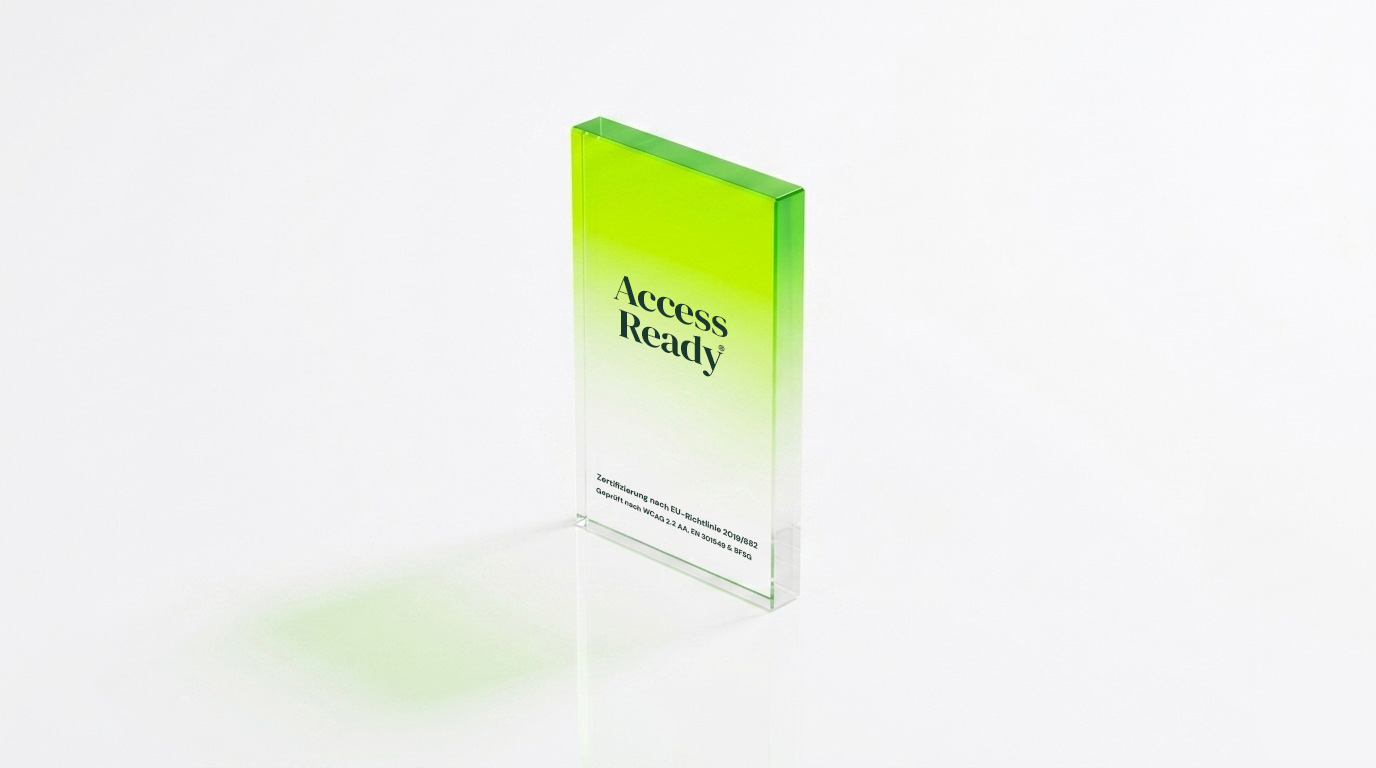
Get started with Access Score®: this free assessment allows you to see, in just a few minutes, where your digital offering currently stands. Access Ready®, our in-depth audit conducted in accordance with EN 301 549 using real users of assistive technologies, provides evidence that is recognised throughout Europe. Once all issues have been rectified, you will receive the ifdb certificate as proof of your due diligence – valid as evidence of compliance throughout the EU. To ensure that this standard is maintained after every deployment, Access Guard® safeguards it through ongoing monitoring.
And Access Protect® safeguards against the very real, country-specific risk of legal action and warning letters by assuming liability under contract. This is the structural advantage it has over any overlay provider – because a script cannot assume liability.
FAQ
Frequently asked questions about the European Accessibility Act
What is the European Accessibility Act, simply explained?
The European Accessibility Act (EAA) is EU Directive 2019/882, which sets out uniform accessibility requirements for a wide range of digital products and services. It is transposed into national law by each Member State and has been in force since 28 June 2025.
What is the difference between EAA and BFSG?
The EAA is the European directive, whilst the BFSG is its German implementation. The EAA sets out the framework, whilst the BFSG governs its practical implementation in Germany. In terms of content, both pursue the same objective.
Does the European Accessibility Act also apply to organisations outside the EU?
Yes. It is not the company’s registered office that is decisive, but the market. Anyone offering products or services to consumers in the EU falls within the scope of the EAA – even if they are based outside Europe. The principle is similar to that of the GDPR.
Which products and services does the EAA cover?
These include, amongst other things, computers, smartphones, e-book readers and self-service terminals, as well as online shops, banking services, telecommunications services, e-books and passenger transport.
Which technical standard applies to EAA compliance?
The EAA refers, through national legislation, to the harmonised standard EN 301 549, which in turn is based on the WCAG. The current standard is WCAG 2.1 Level AA; in future, it will be WCAG 2.2.
What penalties apply for breaching the EAA?
That depends on the Member State in question. Fines range from a few thousand euros to over one million euros. In addition, there may be sales bans and consumer complaints.
How soon do I need to be EAA-compliant?
Since 28 June 2025, new products and services must be compliant from the outset. For existing products and services, a transition period until 28 June 2030 applies in many places.
One market, one standard, one certificate.
The European Accessibility Act establishes a single standard from 27 national sets of regulations – and that is precisely where your opportunity lies. Once you have passed a thorough audit, you will meet the requirements across Europe. Let’s work together to determine how you can achieve this with the least possible effort.
The European Accessibility Act in practice – understanding the European framework, ensuring compliance
The European Accessibility Act is the common European framework for digital accessibility and the basis from which national laws such as the BFSG are derived. Anyone wishing to consult the original text of the directive can find it as Directive (EU) 2019/882 on the EUR-Lex portal, whilst the European Commission sets out the broader context of European accessibility policy on the ‘Shaping Europe’s digital future’ website. Both sources demonstrate that the EAA is not an isolated piece of legislation, but rather part of a long-term European standard.
With ifdb, you can make the transition from the European framework to practical implementation: the free Access Score® compliance scan provides an initial assessment of your current situation; the in-depth audit, accompanied by an ifdb certificate, delivers robust evidence valid across Europe; and Access Protect®’s contractual protection against warning letters safeguards you against country-specific litigation risks. This is how a European obligation becomes a cross-border competitive advantage.