






DIGITAL ACCESSIBILITY · WEB STANDARDS · BFSG · EAA · EN 301 549
WCAG 2.2 – the web standard that makes digital accessibility verifiable in the first place.
WCAG 2.2 forms the technical core of almost every accessibility regulation in Europe. Whether it’s the BFSG, the European Accessibility Act or the EN 301 549 standard – ultimately, they all refer to the W3C’s Web Content Accessibility Guidelines. Anyone who understands what WCAG 2.2 requires understands what a website is actually assessed against. On this page, we explain in simple terms what has changed in version 2.2, which new criteria have been added and how you can provide robust evidence of compliance.
Trusted by leading companies across the DACH region
Featured as an expert on ZDF WISO











What the WCAG 2.2 are and why they set the standard for everything else
The WCAG, which stands for Web Content Accessibility Guidelines, are the internationally recognised guidelines for accessible web content, published by the World Wide Web Consortium (W3C). They are based on four fundamental principles: content must be perceivable, operable, understandable and robust – known in technical terms as the POUR model.
The WCAG recognises three levels of compliance: A as the minimum, AA as the standard relevant to most websites, and AAA as the highest level. For legal compliance in Europe, Level AA is generally the decisive benchmark – and this is precisely the standard set by EN 301 549 and, consequently, by the BFSG and the EAA.
What has changed in version 2.2
On 5 October 2023, the W3C published WCAG 2.2 as an official recommendation. The update is deliberately modest: it builds entirely on WCAG 2.1 and adds nine new success criteria – two at Level A, four at Level AA and three at Level AAA. Anyone who already fully complies with 2.1 is therefore not faced with a new set of rules, but rather with a manageable extension. One notable first has occurred: for the first time in the history of WCAG, a criterion has been removed, namely the technically outdated ‘parsing’ (4.1.1). All in all, WCAG 2.2 thus comprises 86 success criteria. As newer versions are backwards compatible, any page that complies with WCAG 2.2 automatically complies with 2.1 and 2.0 as well.
An overview of the new criteria – explained in simple terms
The new features can be categorised according to the user groups they assist, which makes them more tangible than a simple list of numbers. The first group is aimed at people who navigate using a keyboard or who have a visual impairment: the two criteria regarding the unobscured focus position (2.4.11 and 2.4.12) require that an element controlled via the keyboard must not be hidden behind sticky headers, cookie banners or chat windows. The criterion regarding focus display (2.4.13) ensures that the focus frame is large enough and has sufficient contrast to be recognised at all.
A second group makes life easier for people with impaired fine motor skills. The criterion on dragging (2.5.7) stipulates that anything which works via drag-and-drop must also be operable without a dragging gesture – for example, by simply tapping. The criterion on the minimum size of control elements (2.5.8) sets a lower limit for touch targets, so that buttons and links on a smartphone can be selected reliably.
A third group reduces the cognitive load and applies to virtually every form. Consistent help (3.2.6) requires that help options, such as contact links or chat buttons, appear in the same place across all pages. The criterion on redundant input (3.3.7) prevents users from having to enter the same information multiple times during a process. And the two criteria on accessible authentication (3.3.8 and 3.3.9) ensure that login processes do not rely solely on memory or require users to solve puzzles – passkeys, magic links or pasting from a password manager must remain possible.
What criteria a tool can check – and which it cannot
This is precisely where the most common fallacy lies. Some of the new criteria can be checked automatically: a button that is too small or a missing focus frame can be detected in the code. Others, however, are fundamentally beyond the scope of automated testing. Whether consistent help for the user is positioned in a truly sensible way, whether a login process can be completed without cognitive barriers, or whether a drag-and-drop alternative actually works in everyday use can only be assessed through human review and testing with assistive technologies. An automated scanner therefore provides a valuable initial guide, but does not constitute full proof of compliance.
WCAG 2.2 and the Law – why you should implement it now
At present, the harmonised standard EN 301 549 still refers to WCAG 2.1 Level AA, which is why the BFSG and EAA are currently based on this version. However, the next version of the standard will adopt WCAG 2.2. Anyone who is already testing and rectifying issues against 2.2 today will not only meet the current requirements but will also avoid having to carry out a second, full audit once the new version becomes mandatory. As the update is minor and backwards-compatible, the effort involved is manageable – whilst the advantage gained is long-lasting.
From standard to certification.
How to ensure robust compliance with WCAG 2.2.
Knowing a guideline is one thing; demonstrably complying with it is another. The path to achieving this is clearly structured and starts at a low threshold.
It all starts with Access Score®: our free, in-depth WCAG 2.2 scan automatically checks your website and shows you where you stand in just a few minutes.
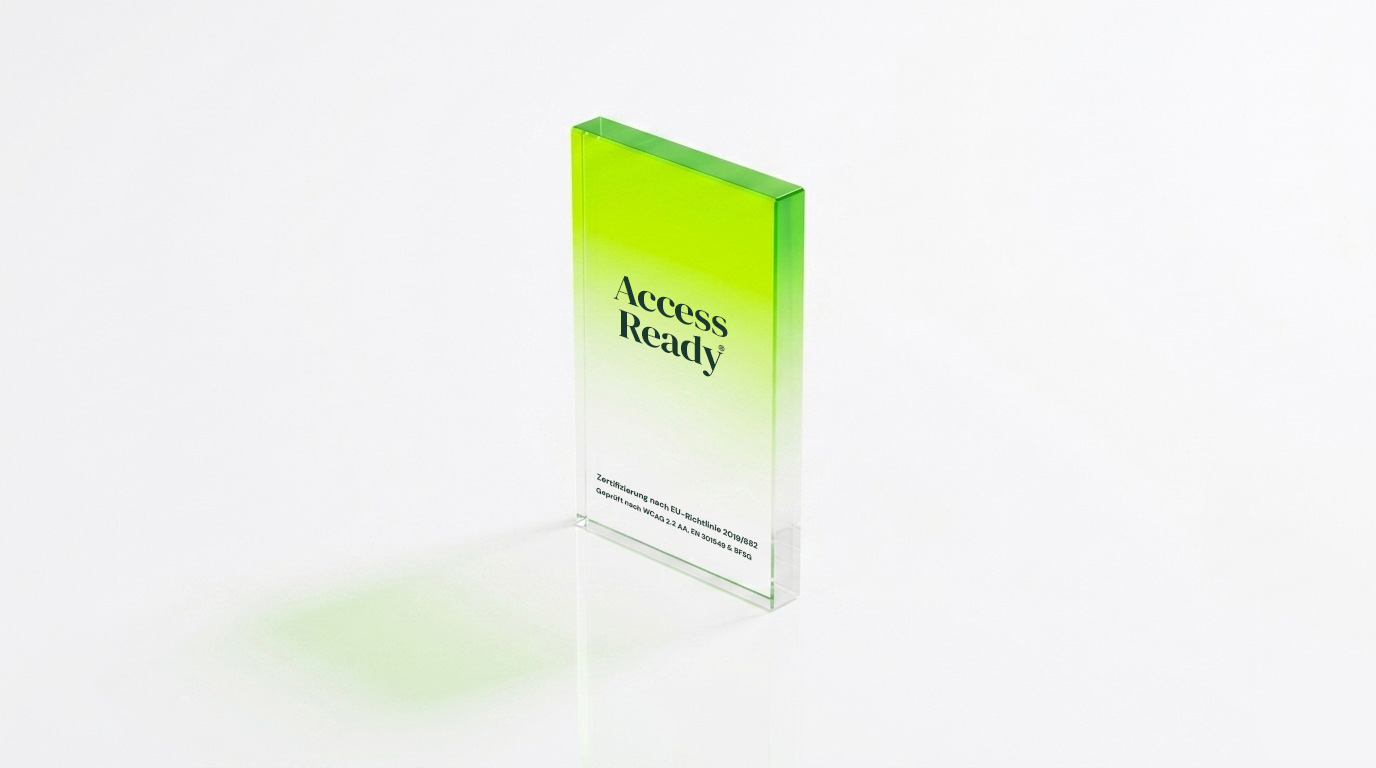
Access Ready®, our in-depth audit involving real users of assistive technologies and testing via JAWS, NVDA and VoiceOver, ensures full compliance – particularly with regard to those criteria that cannot be conclusively assessed by automated means. Once all issues have been rectified, you will receive the legally reliable ifdb certificate as proof of your due diligence.
And to ensure that the level of security achieved is maintained after every release, Access Guard® continuously monitors your systems and flags any new barriers before they become a problem.
FAQ
Frequently Asked Questions
about WCAG 2.2
What is WCAG 2.2, explained simply?
WCAG 2.2 are the W3C’s current Web Content Accessibility Guidelines – international guidelines on how to design digital content to be accessible. They form the technical basis to which legislation such as the BFSG and the EAA refer via the EN 301 549 standard.
What is the difference between WCAG 2.1 and 2.2?
WCAG 2.2 builds entirely on version 2.1 and adds nine new success criteria, for example relating to focus visibility, control size and accessible authentication. A single criterion (parsing) has been removed. Anyone who complies with 2.2 automatically complies with 2.1 as well.
What do the ratings A, AA and AAA mean?
A is the minimum, AA is the standard relevant to most websites and for legal compliance in Europe, and AAA is the highest level. In practice, WCAG 2.2 Level AA is the key target.
Is WCAG 2.2 a legal requirement in Germany?
Indirectly. At present, the BFSG and EAA refer to WCAG 2.1 AA through EN 301 549. The next version of the standard will adopt WCAG 2.2. Anyone who adopts 2.2 now is preparing for the future.
Can an automated tool fully validate compliance with WCAG 2.2?
No. Some of the criteria can be measured automatically, whilst others – such as consistent support or accessible authentication – require human assessment and testing using assistive technologies. Both are needed to provide robust evidence.
How do I demonstrate compliance with WCAG 2.2?
Through a documented audit and a robust certificate. The ifdb certificate from Access Ready® serves as proof of due diligence towards authorities, business partners and the courts.
Meeting tomorrow’s standards today.
WCAG 2.2 is not some distant dream, but the benchmark against which your digital accessibility is measured – today in practice, tomorrow by law. Let’s work together to assess where your services currently stand and how you can most efficiently achieve compliance.
WCAG 2.2 in practice – understanding the web standard, demonstrating compliance
WCAG 2.2 forms the technical core of any serious accessibility strategy and serves as the common point of reference for the BFSG, the EAA and EN 301 549. Anyone wishing to study the guidelines in their original form can find them as the official Web Content Accessibility Guidelines on the W3C website, whilst the Web Accessibility Initiative’s overview of the new success criteria summarises the specific changes introduced in version 2.2. Both sources make it clear that this is not an abstract set of rules, but rather concrete, practical requirements relevant to everyday life.
With ifdb, you can make the transition from compliance with the guidelines to demonstrated compliance: the free WCAG 2.2 scan from Access Score® provides an initial assessment of your current status; the in-depth audit, complete with an ifdb certificate, delivers robust evidence of compliance; and your status remains securely maintained through ongoing accessibility monitoring. This is how a technical standard becomes a practical and demonstrable competitive advantage.