






DIGITAL ACCESSIBILITY · DOCUMENTS · ISO 14289 · BFSG · EN 301 549
PDF/UA – how to turn a PDF into an accessible PDF.
To most people, an accessible PDF looks exactly the same as any other. The difference is beneath the surface – in a clean structure that screen readers can read aloud. This is precisely what PDF/UA, the international standard for accessible documents, regulates. And it is no longer a voluntary extra: under the EN 301 549 standard, documents fall within the scope of the BFSG and the European Accessibility Act. On this page, we explain in simple terms what makes a PDF accessible, how it is tested, and how you can efficiently ensure your documents comply.
Trusted by leading companies across the DACH region
Featured as an expert on ZDF WISO









What PDF/UA is and why accessible PDFs are becoming mandatory
PDF/UA stands for ‘Universal Accessibility’ and, as ISO 14289, is the international standard for accessible PDF documents. First published in 2012, it does not define a new file format, but rather specifies how a PDF must be structured so that assistive technologies can correctly interpret its content.
The idea behind it: PDF was originally designed for printing, not for being read aloud. PDF/UA bridges this gap by tagging content with semantic tags – this makes headings, paragraphs, lists and tables recognisable to a screen reader. A document that was initially just a print layout becomes a structured, readable document.
What exactly constitutes an accessible PDF
An accessible PDF differs from a standard document in several technical aspects that are invisible to the naked eye but are crucial for assistive technologies. At the forefront is what is known as the ‘tag tree’: a logical structure that assigns meaning to each element. A heading is marked as a heading, a list as a list, and a table with its row and column references. This determines the correct reading order, as a screen reader reads in the order of the tags, not in the visual arrangement on the page. In addition, meaningful alternative text is provided for informative images, whilst purely decorative graphics are deliberately labelled as such to prevent them from being read out in a distracting manner. Finally, specifying the document’s language is essential so that the text-to-speech system selects the correct pronunciation. It is only the interplay of these elements that makes a document truly accessible.
The Matterhorn Protocol – how PDF/UA compliance is tested
A standard is only as good as its testability. To turn the abstract requirements of PDF/UA into a practical checklist, the PDF Association has created the Matterhorn Protocol. It translates the ISO standard into 31 test points comprising a total of 136 error conditions, thereby providing the reference framework against which testing tools and audits are benchmarked. Some of these conditions can be tested automatically – such as whether tags are present at all. Others require human judgement, for example, whether alternative text actually describes the image content meaningfully or whether the reading order follows the intended context. It is precisely this combination that explains why a pure software check never tells the whole story about a document.
PDF/UA-1 and PDF/UA-2 – the current version status
With PDF/UA, too, it is worth checking the version. The established and widely implemented version is PDF/UA-1, i.e. ISO 14289-1, which is based on the classic PDF 1.7 format. In March 2024, PDF/UA-2 (ISO 14289-2) was introduced as a fundamentally revised version, based on the more modern PDF 2.0 and comprehensively expanding the requirements for tagged PDFs. For most organisations, PDF/UA-1 is currently the practical benchmark, as software, validation tools and regulatory references are largely based on it. However, anyone setting up new document processes today should already be taking PDF/UA-2 into account to avoid having to switch again in a few years’ time.
Why PDFs are covered by the BFSG and the European Accessibility Act
Many companies check their websites for accessibility whilst overlooking the biggest hidden front: their documents. Yet the legal situation is clear. The harmonised standard EN 301 549 devotes a separate chapter to so-called non-web documents, and it is precisely this that brings PDFs within the scope of the BFSG and the EAA. An inaccessible annual report, a contract form without tags, or a PDF invoice that a screen reader cannot parse are therefore not mere footnotes, but represent a compliance risk. Public authorities and large corporations in particular are sitting on vast backlists comprising thousands of documents – a vulnerability that cannot be addressed overnight and must therefore be tackled at an early stage.
From old inventory to compliance.
How to make your PDFs accessible.
A single document can be made accessible manually. But when there are hundreds or thousands of PDFs, this becomes a bottleneck – and expensive specialists in Acrobat are neither quick nor scalable. This is where the Access Suite comes in.
Access Doc® converts your PDFs into accessible, PDF/UA-compliant documents: reading order, tables, lists and alternative text are properly prepared and reviewed by specialists – either via drag-and-drop in the dashboard or through a bulk API directly from your system. The automated process handles the bulk of the work, whilst human oversight takes care of the remaining complexities. This means that even a large existing backlog can be processed cost-effectively.
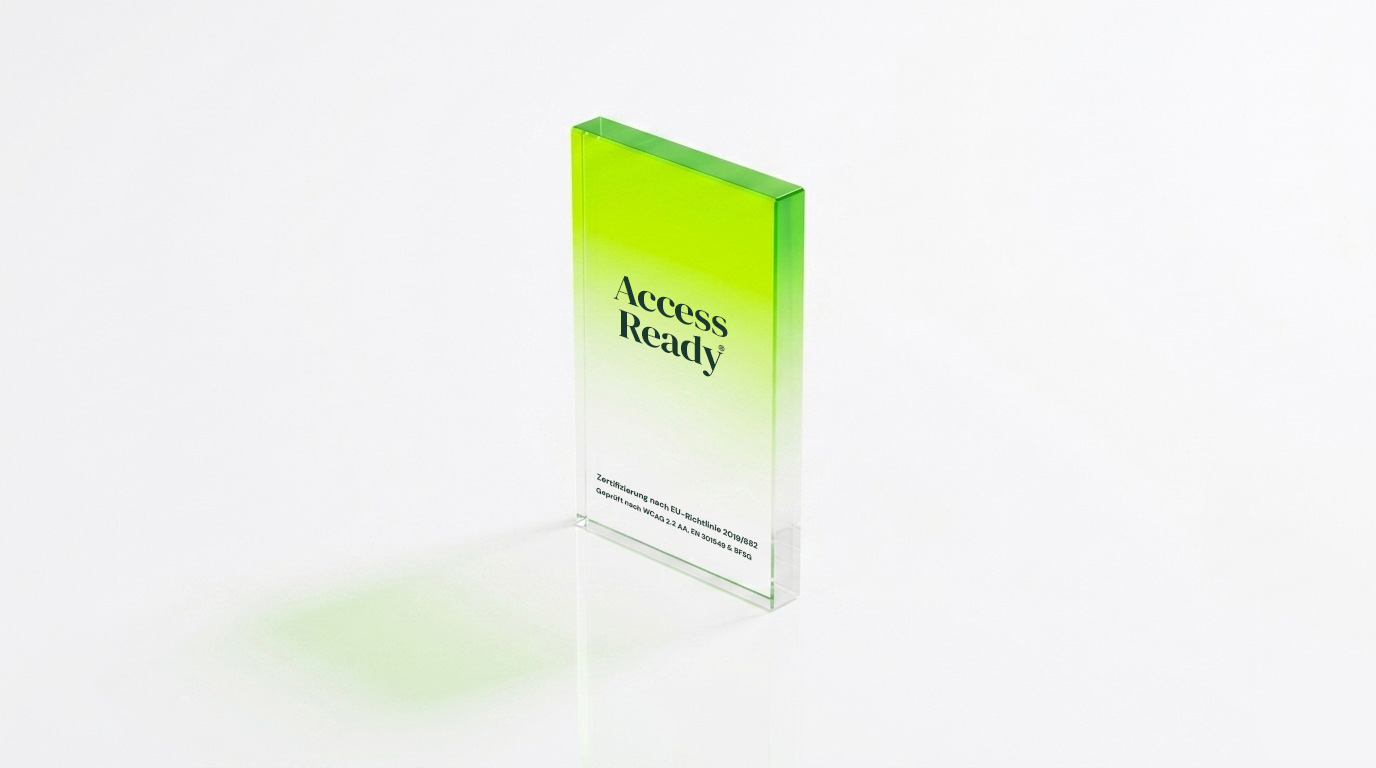
Where documents are particularly complex or legally sensitive, Access Ready® provides a manual, in-depth audit carried out by real users of assistive technologies, along with the robust ifdb certificate as proof of your due diligence. This ensures that your document compliance is not only complete, but also verifiably so.
FAQ
Frequently asked questions about PDF/UA and accessible PDFs
What is an accessible PDF?
An accessible PDF is a document whose content is structured and marked up in such a way that assistive technologies, such as screen readers, can interpret and read it out correctly. The relevant standard for this is PDF/UA (ISO 14289).
What does PDF/UA mean?
PDF/UA stands for ‘Universal Accessibility’ and is ISO standard 14289. It specifies how a PDF must be structured in order to be accessible – for example, through semantic tags, a logical reading order and alternative text.
Is it enough to save a Word document as a PDF?
No. Simply ‘Saving as PDF’ does not usually create an accessible PDF. Only a clean tag structure, the correct reading order and complete alternative text make a document PDF/UA-compliant.
How are accessible PDFs checked?
The PDF Association’s Matterhorn Protocol, with its 31 test points and 136 error conditions, serves as a reference framework. Some of these can be tested automatically, whilst others require manual testing using assistive technologies.
Are accessible PDFs required by law?
In many cases, yes. Under the section on documents in the EN 301 549 standard, PDFs fall within the scope of the BFSG and the European Accessibility Act. Providers concerned must make their relevant documents accessible.
What is the difference between PDF/UA-1 and PDF/UA-2?
PDF/UA-1 (ISO 14289-1) is based on the PDF 1.7 format and is currently the established standard. PDF/UA-2 (ISO 14289-2) was published in 2024, is based on PDF 2.0 and extends the requirements for tagged documents.
How can I convert lots of PDFs efficiently?
With large quantities of documents, this is practically impossible to do manually. Access Doc® recognises structures, tags content and suggests alternative text – via a dashboard or bulk API, supplemented by human review for complex documents.
Cover the flank that the others have overlooked.
PDFs are the blind spot in many accessibility strategies – and that is precisely why they present an opportunity for you to achieve compliance faster than your competitors. Let’s work together to determine the size of your document portfolio and how it can be made accessible most efficiently.
Accessible PDFs in practice – understanding the standard, ensuring documents comply
Creating an accessible PDF in accordance with the PDF/UA standard is an often-underestimated essential part of any compliance strategy. Anyone wishing to gain a first-hand understanding of the basics will find a comprehensive overview of ISO 14289 and the Matterhorn Protocol at the PDF Association, whilst the German-language overview of PDF/UA provides a concise summary of the technical requirements. Both sources demonstrate that an accessible document is not a matter of goodwill, but of clearly defined technical rules.
With ifdb, you can make the transition from the standard to a compliant document: The processing of your collections is handled by Access Doc®’s PDF conversion; the in-depth audit with ifdb certificate provides robust evidence for complex or sensitive documents; and the free Access Score® compliance scan gives you a comprehensive overview of your digital compliance. In this way, an unremarkable file format becomes a verifiable building block of your accessibility.